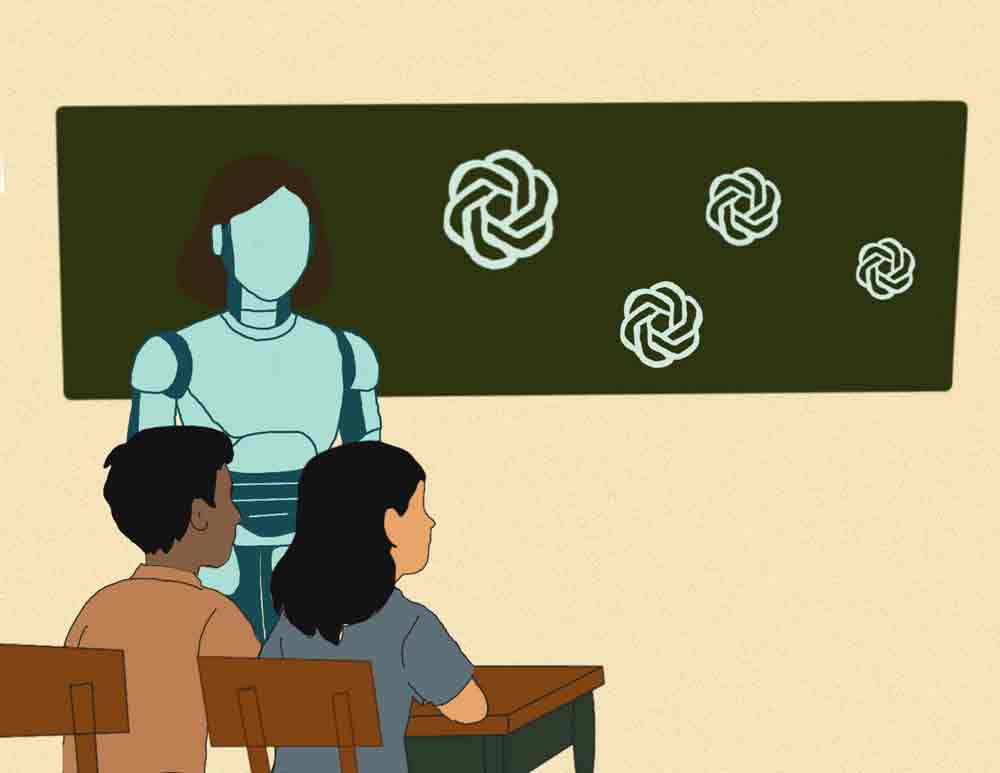
Dr. Amanda Dolan discusses the evolving role of teachers as technology becomes more integrated into learning.
This story is part of a series covering the usage and development of technology within the classroom.”.
Contributers
Audio-Visual: JT Lawrence and S. Brown
Copy-Editing: Michelle Stiber
Graphic Design: Fatima Rasuly
Research & Interview: Naja Young
Research: Alana Lemene
Website Management: Molly Stinchfield
Transcript
“Hello everyone, to Communities of Hope. This week on Tech in Education, we’re exploring one of the more pressing questions shaping classrooms of the future: Is technology going to replace teachers? To help us explore this idea, we spoke with an expert, Dr. Amanda Dolan, a dedicated professor at Southern New Hampshire University whose work focuses on K–12 curriculum development.”
INTERVIEW TRANSCRIPT:
Naja Young: So I’m just gonna start off by asking you to introduce yourself.
Dr. Amanda Dolan: Okay. My name is Dr. Amanda Dolan. I work at Southern New Hampshire University. I am a senior instructional designer and adjunct professor in our graduate education programs.
Naja Young: With the introduction and the evolution of technology and AI within the classrooms, what do you think the future of a typical classroom will look like?
Dr. Amanda Dolan: That’s a really great question and I just to preface, I’ve spent about 20 years in education before moving to higher education. I was in the K to 12 system as, um, an educator. Um, I taught anywhere from preschool all the way up through sixth grade. So I’ve been through a lot of iterations of
technology and changes over the years and now working where I do now, I use a lot more technology. I work for an online university, but when I think about the role of educators and teachers, in particularly in the classroom. I could only think that AI, you know, it’s bringing about rapid change, of course, but the role of teachers is not disappearing.
So I, I want to tell people not to panic because we are needed. It’s not disappearing. In fact, I see it as becoming more complex, more strategic, more relational in nature. Um, AI can help support in a lot of different ways. It, it could help in so many different ways, and I, I could share practical examples as well.
It could help to create more automated, individualized, um, experiences for learners. You know, generate explanations, examples, you know, create practical questions. I, I think we kind of are aware of some of those, but what it cannot do. What we cannot forget is that the act of learning itself is a cognitive endeavor.
Okay? So effective learning involves active engagement and it involves reflection and the practice rather than just being passive. You can’t be a passive participant in learning. So teachers will need to support this cognitive endeavor and it’s going to look a little bit different. But I, in my opinion, I really feel that there could be a lot of benefits in terms of helping to support the building of metacognition, of students helping to form better critical thinking skills, problem solving, um, even helping so far as with executive functioning.
Um, so I think the role of the teacher will really to be very proactive, um, and help to interpret nuance, um, and to provide effective and motivational feedback for learners on their journey
Naja Young: With technology being implemented into schools. Where have you seen the biggest impact on students?
Dr. Amanda Dolan: The biggest things that I’ve seen through just my work as an adjunct, also doing some consulting work in schools.
I, I do see from a student lens, they might think it’s a fast pass, you know, they might think I’m just going to ChatGPT this, I’m just going to AI this answer. And so that is where I do have concerns about the easy button, so to speak, you know, for the learners and not going through the cognitive process. You know, you can almost think of it as a calculator when the technology of a calculator came out.
Um, it’s great it could do the math for you, but if you don’t have the understanding of the number sense. Then it doesn’t pay you any value. So if you don’t know what two represents, the number two represents. If you don’t have that number sense, that’s not an effective tool for you. So the same applies to this new AI tool being used by students in the classroom.
You have to really develop that strong cognitive sense first before using as a tool.
Naja Young: Would it be, would it be fair to say that you think technology, it’s in itself, if used correctly, is a tool as compared to a hindrance to students?
Dr. Amanda Dolan: I absolutely see it as a tool, um, in my experience. Where I am now, where I’m positioned now working in higher education, my part of my job is to develop curriculum to help students be prepared for the workforce.
And we’re entering a work, 21st century workforce, that uses these tools. So if you know how to navigate these tools, think critically about these tools and use an element of human discernment, then you, we are setting students up for success.
Naja Young: How do you think teachers, how would you recommend teachers balance the use of technology, um, with more hands-on skills?
Dr. Amanda Dolan: I think as we shift towards this kind of new era in education, I, I see teachers as becoming architects, designers of, of, cognitive scaffolding and, um, stretch in academic stamina. You know, I see a lot more project based learning, um, coming about and the principles of UDL and backwards design being elevated, um, whenever we and can have students more engaged with
that learning process, the more effective it will become. So I think with, in combination of this tool, if we think about voice and choice and engagement, so if we think about the choice of content, we give students choice of product, choice of process, all with the same end goal in mind, but giving a little bit more liberty on how they’re going to get there and the role of the teacher in helping to facilitate that.
Again, really focusing on the, the, moral reasoning, the, um, social cognition, the metacognition, um, executive functioning, that’s where the role of the teacher will really come into play, and actually, it’s a very complex role. I, I see it evolving to be a very complex role. I, I see our education programs that prepare students to probably involve a lot more developmental psychology type courses and things like that.
Um, which I would love personally, love to see, but I, I, that’s where I see it going.
Naja Young: How do you see technology influencing the way teachers conduct lessons within the classroom and also the way they personalize, the way they teach the curriculum?
Dr. Amanda Dolan: I think there’s a lot of opportunities. I think it cannot be something that is haphazardly or hastily, um, kind of constructed in terms of lessons, I think.
When you use AI as a resource in the classroom, it needs to be incredibly intentional. Um, because the role of the facilitator of learning, the role of the teacher is to ensure that a student is actively engaged, is actively reflecting, is actively building skills. So. I don’t, in the same way that I don’t think it’s an easy kind of pass for students.
I, I, I, again, I’ll go back to the role of the educator becoming much more complex because they are now designing scaffolding lessons with, um, new tools. But with that in mind. We do have the opportunity, and I’ve used it in practice where we are able to give much more, um, strategic and actionable and quick feedback to learners.
We are able to really adapt to the needs and differentiate to those learners, um, when we could build that in. Um, recently I’ve worked with a student who is, um, in his late sixties ,and he for years has struggled with learning. Um, he has severe dyslexia and we have used AI and ChatGPT as a tool to help him express all of the knowledge that is in his head, um, and, and get it out on paper.
He is actually writing a dissertation right now and he’s an incredibly accomplished, brilliant man who’s had a lifelong career of success, but within the traditional school structure, he didn’t always fit in. He was the square peg and he wasn’t always able to communicate his ideas. He wasn’t always to write the paper that he needed to write.
And so, backwards designing his learning experience from his end goal and using AI as a Socratic companion to help ask questions and to kind of navigate some of those barriers that he’s faced before. Um, that’s really helped to operationalize, um, and lead to very successful learning outcomes for him.
Naja Young: Do you think that AI usage should be taught prior to high school?
Do you think that it should be something introduced to kids in elementary school or should be taught later?
Dr. Amanda Dolan: Students are exposed at an early age to a lot of digital technologies, and I think to be, um, responsive in the classroom, I think it’s important. Um, I was in the classroom back, you know, 20 years ago when we were teaching students how to Google and you know, how do we understand if this is a real website or a fake website? How, how do we know if this is actual, you know? So we had to teach those kind of critical thinking skills back then. So I think this, it’s, it’s come full circle again, and I think we’re at that stage where we have a new technology.
Granted, it’s, it’s rapidly evolving. Um, we, it’s, it’s imperative that as educators we are teaching digital literacy and responsibility when it comes to these tools. Absolutely.
Naja Young: With the speed of technology evolving, do you think it’s moving too quickly or too slow? And do you think that teachers should be evolving at the same speed as technology?
Dr. Amanda Dolan: I mean, it, it’s, it’s the, the horses are out of the gate at this point, you know, so it’s unfortunate, like it is going so fast. And, and I think for, for educators, um. I know for, for myself, weekly professional development, I have a number of like online educator magazines that come into my inbox every week and just kind of tag the headlines, what’s new, what’s happening?
You know, I, I think there’s no possible way for us to keep up in real time, but it’s our responsibility to understand the general landscape. And I think it’s our responsibility as providers and guiders of learning to do our best to understand that landscape and engage with it ourselves. I know that I’m constantly learning.
I’m constantly participating in professional development, but that is why I became a teacher. It is so I myself could constantly be learning and evolving and as we prepare students, whether we’re preparing second graders, high schoolers, or college-age students, we have to evolve so that we can help our students evolve.
Naja Young: With the size of classrooms and the pressure that is placed on teachers, have you seen an increase or do you predict that more teachers will start relying heavily on technology and AI to relieve some of that stress?
Dr. Amanda Dolan: And I could say that in my own practice, I have taken on more AI in my daily tasks, and I’ve used it for, um, scheduling. You know, meetings are wonderful when you could have an AI transcription and have it summarize what happened in a meeting, you know? Um, and as you know, classroom sizes and as this landscape of education continues down this path, I do see educators becoming more open to using AI. Um. As, as much as I, I do embrace it.
I cautiously embrace it. You know, I, I don’t wanna say here I’m promoting it. I do that with the caveat that I have gone through a number of certifications and professional developments and things like that to take the time to learn about it. So, I do recognize, however, with time constraints, and, and teaching loads and such, teachers will inevitably more likely rely on the use of AI.
I just hope that they do so in a responsible manner.
Naja Young: What are some aspects of teaching that you feel AI or technology won’t be able to replicate within the classroom?
Dr. Amanda Dolan: You can never take out the human impact of a teacher and their role in the classroom as being a facilitator. Um, the facilitator of knowledge that, like I, I mentioned before, kind of that architect that, you know, creates the learning experience.
But I, I think the human elements that. That come down to the very basic process of learning is that active engagement and that cognitive endeavor that the student is participating in, and they need a guide. They need that teacher to help support in that journey. They need to help support and understand what that student needs for engagement, what that student needs for differentiation, what that student needs in order to help them reflect and build those critical thinking skills, those metacognition skills.
Um, and even as we introduce these technologies, like think about. You know, moral reasoning, um, and identity in relation to I A I, AI, excuse me. Um, even the social cognition pieces that apply to it. So, the role is going to become much more nuanced. But those, those human elements and aspects, you know, when a student is working, um, at something and they’re working to figure out fractions, and yes, they might be able to use some sort of an AI tool to help support them in that learning, but there’s gonna still be a student that’s frustrated, you know, and you still need someone to help them navigate those feelings.
Um, so really it’s important to think about, you know, the effective and motivational role that the teacher will have and what feedback that they provide and helping them to sustain, um, that level of, um, persistence and rigor. So it’s, it’s just going to become a much more dynamic role.
Naja Young: With the increase of technology in the classrooms with the use of iPads and iReady and all these things, have you seen a decline in fine motor skills for younger students?
Dr. Amanda Dolan: I actually have. I have noticed that quite a bit. Um, and I think, I think we’re quick to judge and say it’s because of the classroom. I think it, it’s, it’s holistic. I think we need to look at, you know, what’s happening in the home and what’s happening in all aspects of, um, society. But I have noticed that as well.
Um, you know, my, my, my own children are much older, but anecdotally, you know, I, I do see peers who have small children. From a very young age, they’re on iPads and they’re, you know, some of their games that they’re playing. They’re no longer playing those tactile games with manipulatives or stringing the beads on a chord.
You know, they’re, they’re playing games that are more digitalized, you know, so that’s a natural outcome.
Naja Young: How do teachers balance the need to teach students about navigating the web while also teaching them the foundational skills that they need to be functioning adults?
Dr. Amanda Dolan: That’s a very hard balance.
Because, and that, you know what, that speaks to human nature too. Like that speaks to the management of, and, and probably that kind of like psychological kind of role that the, the teacher has in the classroom and understanding the human development. So balancing that need to be often quite precarious at time because we do live in a society where, um, our students now are all digital natives and, you know, access to information has always been, you know, transparent. It’s always been immediate. And so navigating that, um, requires a great, um, bit of organization in classroom management, um, and setting clear expectations and boundaries.
Naja Young: Well that was the last question I have for you.
Are there any questions that you have or anything that you wanted to talk about?
Dr. Amanda Dolan: One of the things I just wanted to really emphasize, and I think I I, I noted this through anecdotally, through working with this student, um, who had spent years, you know, going through school, K to 12 system, went onto advanced degrees, led a very professional career success, immensely successful career.
Um, but I, I do notice that, and, and I think he was the one who really kind of opened my eyes, the potential, um, of AI and the opportunity it brought. ‘Cause at first I was a little bit more hesitant. This was a few years ago before I started taking classes. Um, is it’s a great opportunity to build equity in the classroom and to help with differentiation.
With that said, it needs to be done in a, a systematic, controlled manner, but, to, to watch an adult whose spent nearly seven decades struggling and to now watch him, you know, earn his doctorate and finally feel psychologically safe in the classroom is an immense feeling. It’s an immense result of having this tool.
So. That is something that I think about as I move forward, as I try navigate some of the negative and some of the polarizing kind of thoughts and feelings on AI. I think of this positive outcome and I think of some of the classes I’m designing now that provide automated feedback, you know, in the now so they could do those formative, um, checks and balances and, you know, to help with that student engagement and help with the differentiation.
And I think this can be good if used properly and responsibly.
Naja Young: Thank you. You’ve been so great. This was really good.
Dr. Amanda Dolan: Alright. I hope I helped.
Naja Young: You did. You did so much. Thank you.