
A closer look at recent statistics highlights changes in housing, education, and public resources.
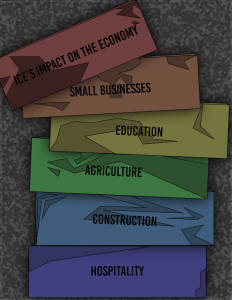
Seven months into President Donald Trump’s term, immigration enforcement increased across the country. The effects started to show, not just in people’s daily lives, but in the economy as well. Actions by U.S. Immigration and Customs Enforcement, also known as ICE, impacted individuals and families and resulted in consequences for jobs, schools, and local businesses.
When large-scale raids took place in areas like Los Angeles, fear spread quickly through communities. Many people became afraid to leave their homes, even for everyday activities like going to work, school, or the grocery store. This fear had a direct effect on the workforce. In 2025, during the week of June 8 to June 14, California saw a 3.1% drop in labor force participation. That might not sound huge at first, but in a state as large as California, that represents thousands of people suddenly not showing up to work. This steep dip matters because the economy depends on people being able to work consistently. When workers are absent, businesses struggle to operate at full capacity. This was especially clear in industries that rely heavily on immigrant labor.
One of the most affected industries was agriculture. Between March and July 2025, the agriculture sector lost about 155,000 workers. This is a major loss, especially because agriculture depends on a steady workforce to plant, harvest, and process food. When there aren’t enough workers, crops can go unharvested, which leads to financial losses for farmers and can even impact food supply and prices.
The construction industry also saw changes. In the ten states with the highest number of undocumented construction workers, employment dropped by 0.1%. At the same time, other states without as much reliance on immigrant labor saw growth of about 1.9%. This contrast shows how immigration enforcement can affect regions differently depending on their workforce. In areas where immigrant workers make up a large part of the labor force, even small disruptions can slow down entire industries.
The hospitality industry, which includes jobs in restaurants and hotels, also experienced a dip in growth. In June 2025, the labor force only grew by 0.2%, compared to 1.5% in June 2024. This suggests that businesses in the hospitality sector were either struggling to find workers or were seeing fewer customers, or both. Since hospitality depends heavily on both workers and customers being present, it is especially sensitive to changes like these.
In addition, the impact of increased ICE enforcement stretched past employment and into education systems. In some communities, school attendance dropped by 22%. Many parents were worried about their safety or the possibility of being separated from their children, so they chose to keep their kids at home. This has long-term consequences on students’ learning and development. This choice also affects school funding, since many schools receive funding based on their students’ attendance.
Local and small businesses that depend on immigrant communities, like food trucks, local markets, and neighborhood shops, served fewer customers during this period. When people are afraid to go out, they spend less money, and that hurts these businesses. Even people who were not directly affected by immigration enforcement could feel the impact through slower business activity and fewer services available in their communities.
Another important factor was the increased use of E-Verify. This system allows employers to check whether someone is authorized to work in the United States by comparing their information with government records. As more employers were required or encouraged to use E-Verify, it became harder for many immigrants to find jobs. This added another layer of difficulty for people already dealing with fear and uncertainty.
All of these effects are connected. When workers don’t show up, businesses lose productivity. When businesses slow down, they may hire fewer people or reduce hours. When families are afraid, children miss school and communities become less active. Over time, these changes add up and create a noticeable impact on the local economy.
Overall, the data shows that increased immigration enforcement doesn’t just affect the people directly involved. It creates ripple effects that spread through entire communities. From job losses in agriculture and construction to lower school attendance or struggling local businesses, the economic impact is widespread. These numbers help tell a bigger story, one about how policy decisions can influence not just individuals, but the health and stability of entire communities.
Audio-Visual: Shania Brown and JT Lawrence
Copy-Editing: Michelle Stiber
Graphic Design:
Research & Script Writing: Ana Dwyer and Ashlyn Keating